


-
 Vincent Barré, Monotype 4, 2020
 -
Vincent Barré, Monotype 10, 2020
-
Frank Mädler, Mitte-oben rot, 2018
-
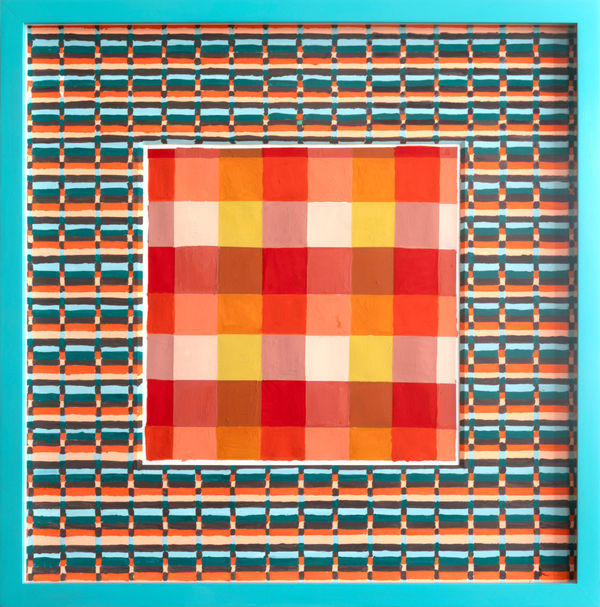
Michelle Forsyth, Purple and Yellow Florals on Red and Blue Plaid, 2024
-
Michelle Forsyth, Orange Stripes on Orange plaid, 2024
-
Michelle Forsyth, Orange Gingham on Green Plaid, 2024
-
Michelle Forsyth, Grey and Black Houndstooth on Yellow Geometric, 2023-2024
-
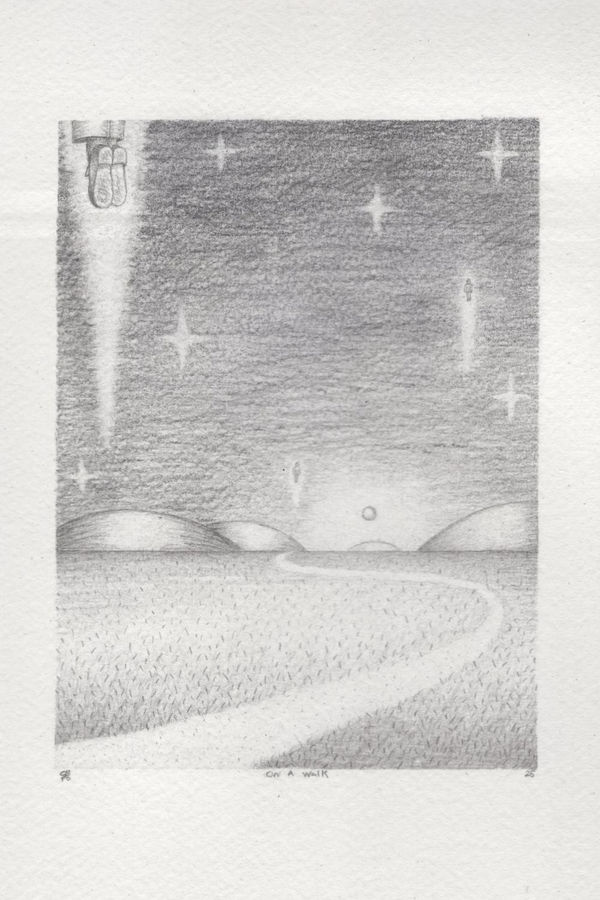
Christian Butterfield, On a Walk, 2025
-
Peter Campbell, Cascading, 2022
-
Colectivo MANGLE, Porra 10 libras, 2015
-
Jota Castro, Hybris (Miss Liberty and Lego), 2019
-
Marepe (Marcos Reis Peixoto), Set of Calabashes (bottle gourd), edition of 3, 2007
-
Virgil Baruchel, Astral project(ions), 2024
-
Peter Campbell, View From a Train, 2026
-
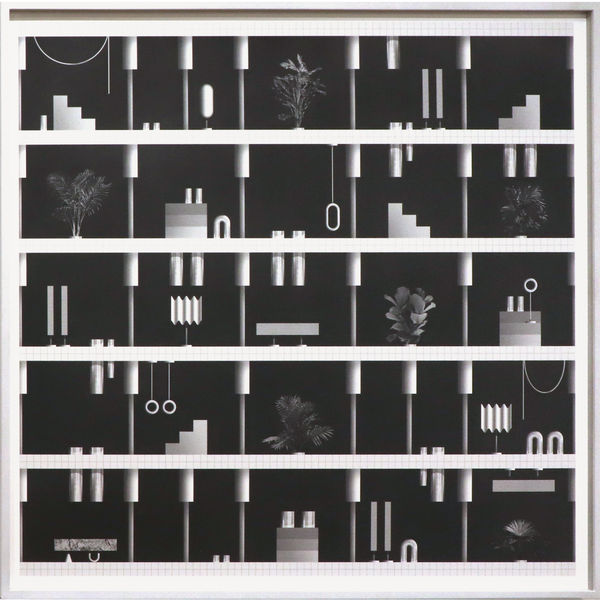
Miles Gertler, Scenario City 03, 2017
-
Andrés Marroquín Winkelmann, Puente.02, 2012/2014
-
Barbara Astman, Woven Stories #49, 2023
-
Hana Elmasry, A Tender Passage, 2026
-
Danielle Vincent, Impasse, 2024








Vertices is an exhibition responding to the growing presence of barriers and borders, and the ways we choose to navigate them. Rather than seeing divisive lines as limits, Vertices proposes them as points of encounter—spatial and mental places where ideas and voices can meet, intersect, and move fluidly between one another.
The artists in the exhibition approach questions of identity, belonging, place, memory, and community through diverse materials and perspectives. Together, their practices consider how differences can coexist, and how encounters between them can create space for dialogue.
Vertices reflects on what we have built collectively and the value of community, while considering the possibilities of continuing to build together.
Barbara Astman (Canadian, b. 1950, Rochester, NY), Virgil Baruchel (Canadian, b. 1986, Paris, France), Vincent Barré (b. 1948, Paris, France), Frank Mädler (b. 1963, Leipzig, Germany), Colectivo Mangle (b. 1978, 1984, Bogotá, Colombia) and Marepe (b. 1970, Bahia, Brazil) explore materiality through mixed-media practices. Astman and Baruchel examine the public domain and our interactions with media and social media, while Mädler, Colectivo Mangle, and Marepe push the possibilities of diverse materials and media to comment on the beauty of mundane gestures.
Peter Campbell (b. 1996, London, ON), Andrés Marroquín (b. 1983, Lima, Peru), and Danielle Vincent (b. 2002, Oakville, ON) look to the landscape to examine borders and limits as human impositions. In contrast, Christian Butterfield (b. 1995, Toronto, ON) imagines surreal spaces where borders become fluid and undefines.
Hana Elmasry (Canadian, b. 1990, Cairo, Egypt) multiplies views of a physical space to imagine the possibilities of passage. Similarly, Miles Gertler (b. 1990, Toronto, ON) plays with perception by bringing together points of coexistence between natural and constructed environments.
Michelle Forsyth (b. 1972, Vancouver, BC) explores identity and memory through visual abstraction, connecting vertices of colour to trace the passage of time and celebrate new paths in life. Jota Castro comments on political realities by addressing the imposition of borders through humour and absurdity. In this work, he places a wall of Lego in front of a figurine of the Statue of Liberty.
Barbara Astman is at the forefront of the intersection of technology and art. Astman has a career spanning over 50 years. She pioneered the artistic use of both analog and digital techniques and was among the first to explore technological practices and concepts that have become key elements of contemporary art. Born in Rochester, New York, Astman came to Canada in 1970 and later taught at the Ontario College of Art and Design University, where she became Head of the Department of Photography. Major public, corporate, and private collections internationally represent her work. In 2024, Astman received the Governor General’s Award in Media and Visual Arts.
Vincent Barré is a French sculptor, architect, and filmmaker whose practice has shaped the French cultural scene for over 50 years. After studying architecture in Philadelphia under Louis Khan and working with the firm Barton Myers in Edmonton and Toronto, Barré returned to Paris and devoted himself to his artistic practice. Known for his cast-iron and bronze constructions, he explores the relationship between the human form, architecture, and landscape. His large-scale public sculptures can be found across France, Germany, and China. Barré has exhibited internationally and taught at institutions in Europe, Asia, and North America. From 1995 to 2011, he led a sculpture workshop at the Beaux-Arts de Paris. The integration of art into outdoor and public spaces remains central to his practice. Born in Vierzon, France, in 1948, he lives and works in Paris, Normandy, and Loiret.
Virgil Baruchel works in the traditions of pastel drawing and weaving, portraying abstracted human forms in electric colours imbued with irony and humour. His practice explores the relationship between the outward-facing self and the private, inner self, using layered pastel, oil stick, and tactile weaving to play with transparency and exposure. Drawing from his Egyptian and Moroccan roots, Baruchel brings traditional weaving into dialogue with contemporary technology, with individual knots mirroring digital pixels. He is a Parisian-born Canadian based in London and has exhibited in Canada, the United States, England, Switzerland and France.
Christian Butterfield draws inspiration from the history of traditional portraiture and avant-garde movements. His paintings combine paint and collage to create narratives of desire, love, and forgiveness, often incorporating imagery from historical and contemporary sources. Moving from portraiture to figurative abstraction, Butterfield has recently turned to landscape, creating otherworldly and surreal scenes through richly textured applications of paint. His work explores spaces where reality and imagination meet. He is local to Toronto.
Peter Campbell is an early-career artist whose tactile, luminous paintings elevate familiar yet often overlooked patterns found in natural phenomena and everyday objects. Interested in evolutionary processes and the rhythms of the natural world, Campbell layers paint to mimic natural and human-made forms. His intricate patterns and pathways create mesmerizing paintings that explore the possibility of multiple worlds. Campbell holds a Bachelor of Fine Arts from Concordia University and studied under painter Leopold Plotek. In 2025, he received the Elizabeth Greenshields Foundation project grant.
Jota Castro is an activist artist who champions intellectual freedom and democracy. Born in the Peruvian rainforest and now based between Brussels, Belgium and Dublin, Ireland, his practice examines contemporary consumer society, often through biting, politically incorrect humour. Working in a visual language described as political minimalism, Castro addresses subjects including migration, genocide, oil dependency, global trade, and the destruction of the Amazon rainforest driven by Western consumption. His work creates an arena for free speech and the possibility of hopeful, radical alternatives.
Hana Elmasry is a Toronto-based painter whose practice investigates spatial logic and sequential perception through abstraction, geometry, and translation. Working through Cubist principles of multiple viewpoints and geometric decomposition, she treats painting as construction rather than representation: figures, architecture, and atmosphere become spatial problems through which perception is tested. Her paintings operate between recognition and dissolution, with forms remaining partially legible while breaking into planes and passages of paint. Informed by cognitive science and Kant’s account of aesthetic judgement, she approaches ambiguity as an active perceptual condition — one the viewer must continually assemble and revise. Hana holds a BFA from OCAD University and a degree in Cognitive Science from the University of Toronto. Her work was featured in Being and Belonging: Contemporary woman artists from the Islamic World and Beyond at the Royal Ontario Museum, which also holds her work in its permanent collection.
The work of Michelle Forsyth explores notions of time, memory, and resilience in the domain of the quotidian. For over a decade, she has developed her fascination with domestic objects as a way to understand the different stages of her life. Working across sculptural objects, hand-painted backdrops, pattern design, and fabric printing, Forsyth uses meticulous, repetitive processes to explore identity and the passage of time. Her work has been exhibited internationally, and she currently holds a tenured position at OCAD University.
Miles Gertler is a designer, artist, and founder of the conceptual practice Common Accounts, which he co-directs with Igor Bragado. Gertler studied architecture at Princeton University and has since translated his background in design into art practices rooted in contemporary and techno-cultural discourse. His work spans research, experimental installations, image making, sculpture, writing, and exhibition-making, exploring how self-design occupies digital and material domains. His work has been exhibited internationally, including at the Museum of Contemporary Art Toronto, the Venice Architecture Biennale, and the Seoul Biennale of Architecture and Urbanism. He is Assistant Professor at the University of Toronto’s Daniels Faculty of Architecture, Landscape and Design.
Colectivo MANGLE, formed by María Paula Álvarez and Diego Álvarez, focuses on wood, following its grain and natural forms to create furniture inspired by nature. The name MANGLE translates to mangrove, a tree that thrives in difficult environments through a tangled and strong root system. The collective works with wood as a noble material that adapts and transforms while retaining its vital qualities, reflecting on beauty as an inherent quality of the natural world. Colectivo MANGLE lives and works in Bogotá, Colombia.
Working within the realm of abstract realism, Frank Mädler creates large-scale photographic works inspired by landscapes and fleeting moments of everyday life. His compositions juxtapose colour, space, and a sense of time, blurring the lines between reality and illusion. Through experimentation with traditional photographic techniques, including exposure and film grain, Mädler creates images with an ethereal and atmospheric quality. Born in Germany, he studied at the Academy of Visual Arts in Leipzig, where he continues to live and work.
Andrés Marroquín Winckelmann is a multidisciplinary artist whose work explores the ambiguity of Modernism in Latin America. His practice examines the history of industrial materials and their insertion into the Peruvian landscape, as well as systems of communication. Marroquín trained in Communication Studies and photography in Germany and Peru. In addition to his artistic and publishing practices, he is a university professor in Lima, Peru. His work has been presented internationally, including at the Mercosul Biennial in Porto Alegre, Brazil.
Marepe was born Marcos Reis Peixoto in San Antônio de Jesus, Bahia, Brazil, in 1970. His work is deeply connected to the local traditions, customs, and materials of Bahia, a region predominantly populated by descendants of enslaved Africans. Working with readymade materials, everyday objects, and familiar activities, Marepe’s practice has developed a complex layering of cultural references and meanings. He has exhibited nationally and internationally since the early 1990s, including at the Centre Pompidou in Paris and the Venice and Istanbul Biennales. He lives and works in Salvador, Bahia.
Toronto-based Danielle Vincent explores themes of stability amidst life’s transitions. Working through intimate oil paintings, she examines the threshold between the comfort of familiarity and the disquiet of ambiguity. Drawing from personal and family photographs, Vincent explores immaterial boundaries within relationships and society, creating liminal spaces that evoke anticipation, impermanence, and alienation. Her paintings invite viewers to reflect on their own experiences of in-betweenness. Vincent graduated from the BFA program at OCAD in 2024.


